A new tool for understanding biodiversity risks
Our Bank developed the Country Biodiversity Risk Index, understand how this index helps Financial Institutions navigate the biodiversity challenge.
Growing evidence points to biodiversity loss as a critical environmental challenge with direct implications for economic stability and business continuity. Ecosystem degradation can disrupt essential services from pollination to carbon storage and flood protection, creating operational and supply chain vulnerabilities. The World Economic Forum states that more than half of the world's GDP, $44 trillion, depends moderately or strongly on nature. This systemic importance is reflected in the ECB's decision to explicitly integrate nature degradation into its monetary policy strategy assessment, alongside climate change.
What is the Country Biodiversity Risk Index (CBRI)?
Crédit Agricole CIB has developed the Country Biodiversity Risk Index (CBRI), a framework designed to assess biodiversity-related risks at the national level. Combining 43 indicators across four dimensions, the methodology provides a structured approach to evaluating nature-related risks across nearly all global territories. This enables financial institutions to identify biodiversity exposure concentrations throughout complex international value chains and across their lending and investment portfolios.
How does the CBRI work?
The CBRI evaluates:
- Ecosystem health: how intact are a country's ecosystems notably forests, wetlands, and marine environments?
- Species conservation status: how many species face extinction, and how severe is the threat?
- Anthropogenic pressures: what human activities are driving biodiversity loss - from deforestation to pollution?
- Protection measures: how effectively is the country protecting its natural resources?
Key findings
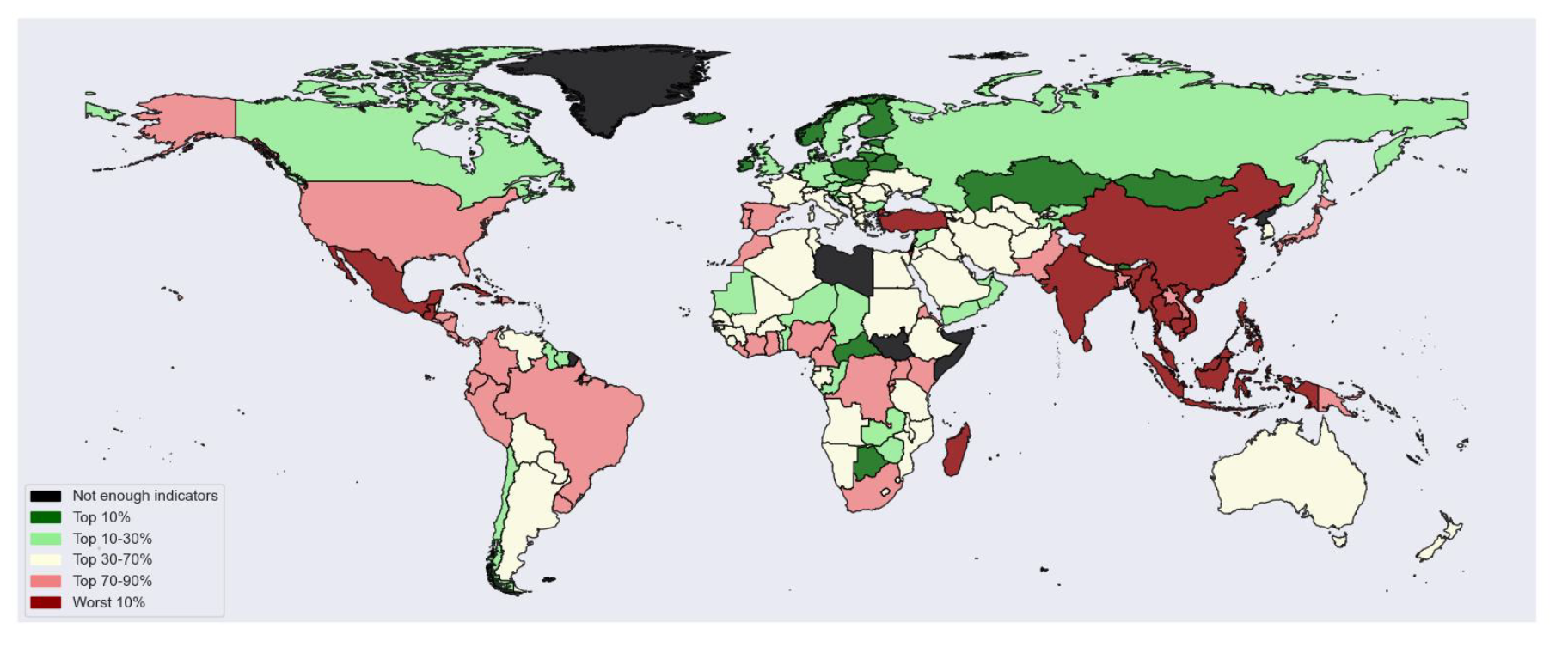
This research demonstrates that highest-risk countries cluster in rapidly developing megadiverse regions (China, India, Southeast Asia, tropical South America, and parts of Africa) where high species richness coincides with accelerating habitat conversion and industrial expansion. Conversely, lowest-risk countries include sparsely populated regions and post-industrial nations with stabilized land use.
Critically, regions experiencing the most rapid economic growth face some of the highest biodiversity-related risks, suggesting a potential increasing trend in the nature-related risk exposure of financial portfolios.
Applications for Financial Institutions
The CBRI provides Financial Institutions with an innovative methodology to:
- Conduct preliminary biodiversity risk screening across lending and investment portfolios
- Identify geographic concentrations of nature-related risk in supply chains
- Support enhanced due diligence in high-risk jurisdictions
- Prepare for evolving nature-related disclosure requirements, including the Taskforce on Nature-related Financial Disclosures (TNFD)
Ready to better understand biodiversity risks in your business operations?
Download the complete Country Biodiversity Risk Index paper to discover how this innovative methodology can help you navigate the complex relationship between business and nature.
- EnglishPDF1.79 MBDownload the full CBRI research paperDownload the full CBRI research paper
“Several valuable frameworks exist in this space, notably the Yale Environmental Performance Index (EPI) and WWF's Biodiversity Risk Filter, and we've built on their important work.
However, each has a different focus that creates, in our view, some gaps for financial institutions. The CBRI addresses these gaps by focusing exclusively on biodiversity across four integrated dimensions (ecosystem health, species status, anthropogenic pressures, and protection measures). This four-pillar approach is our core innovation. It captures both a static view and a forward-looking perspective:
- The static view (Ecosystem Health + Species Conservation Status) shows you where biodiversity stands today.
- The forward-looking view (Anthropogenic Pressures + Protection Measures) reveals where biodiversity is heading.
This research represented several months of work and required collaboration across the Environmental & Social Risks department of Crédit Agricole CIB with key technical contributions from Loïc Marcadet of Nexialog Consulting who structured the underlying data architecture.
While the framework is now operational, we view this as a living methodology that is designed to evolve as biodiversity science and data availability improve.”
Thomas MORIN, Crédit Agricole Corporate & Investment Bank
Gisèle DUCROT, Crédit Agricole Corporate & Investment Bank
Diego MATALLANA ALBORNOZ, Crédit Agricole Corporate & Investment Bank
- Sustainable financeArticle06/10/2026
Crédit Agricole CIB supports Hong Kong SAR Government’s record-breaking fourth digital green bond issuance
- Sustainable financeArticle04/08/2026
Crédit Agricole CIB supports the largest green project finance transaction for a single data centre in Malaysia
- Sustainable financeArticle11/06/2026
Climate adaptation conference: from physical risks to adaptation finance


